
An affordable bookkeeping service for a restaurant
Get your bookkeeping done the right way so you can focus on your patients when they open their mouth.
Bookkeeper for restaurants and cafes
Do any of these financial scenarios sound familiar as a restaurant operator?
- Your POS system and your bank account never seem to reconcile and you are not sure why
- You know your food costs are eating into your margins but you cannot see exactly where
- Your delivery platform settlements from Uber Eats, DoorDash and Menulog are a mess to track
- You are processing payroll for casual staff but are not confident the hospitality award rates are right
- Your BAS gets lodged late, or gets done in a rush on figures you are not entirely sure about
- Super for your casual team is confusing and you are not certain it is being paid correctly or on time
- Your accountant cannot start your tax return until the books are cleaned up, and that conversation gets uncomfortable every year
- You have no reliable picture of what the business is actually making after food, labour and running costs

If any of these sound like your practice, you are not alone and there is a straightforward fix.
Running a restaurant means carrying two jobs simultaneously, one as the person responsible for what comes out of the kitchen, one as the business owner responsible for what goes out of the bank account.
The food side is what you built the business around. The financial side is what determines whether you get to keep doing it.
Somewhere between the lunch service ending and the dinner service starting, the bookkeeping either gets done properly or it gets done quickly, and in a business operating on margins as tight as a restaurant, those two things are rarely the same.
Running a restaurant is hard enough without the books becoming another full-time job
You opened your restaurant because you are good at something that takes real skill and real passion. The food, the service, the experience of a full dining room on a Saturday night. What you almost certainly did not plan for was the financial administration that comes with it, and how much of your time and energy it would consume.
The numbers around a restaurant are unforgiving.
According to CreditorWatch data, food and beverage services leads all Australian industries for business failure rate, with more than one in ten hospitality businesses closing permanently in the past year.
That is double the economy-wide average, and it is the highest failure rate of any industry tracked. Behind most of those closures is not bad food or poor location. It is cash flow problems, unmanaged costs, and financial records that were not maintained well enough to give the owner a clear picture of what was happening until it was too late.
Professional bookkeeping does not guarantee a restaurant succeeds but not having it in place removes the financial visibility that makes managing a restaurant viable, and replaces it with guesswork at the exact point where precision matters most.
Why more than one in ten restaurants close every year and what the bookkeeping has to do with it
A restaurant has one of the most complex financial profiles of any small business, and the bookkeeping requirements reflect that. The specific challenges that come up consistently in hospitality businesses include:
- Multiple revenue streams arriving through different channels at different times. A single day of trading might include dine-in card payments, cash, Uber Eats settlements, DoorDash settlements, Menulog settlements, function deposits, gift voucher redemptions and BYO corkage.
Each arrives in the bank through a different channel, with different fees deducted, on a different processing timeline. The POS system records what was sold. The accounting system needs to reflect what was actually received, with each channel correctly separated and reconciled.
When these two sets of numbers do not match, everything downstream from that reconciliation is unreliable.
- Food cost as a moving variable that directly impacts profitability. Food and beverage costs typically sit between 28 and 35 percent of total revenue for a restaurant. A supplier price increase of even a few percent on key ingredients changes the margin on multiple dishes simultaneously.
Without a current, accurate cost of goods sold figure updated from reconciled supplier invoices, menu pricing decisions are made on estimates rather than facts.
Most restaurant owners who are losing margin do not know exactly where it is going until a bookkeeper starts tracking it properly.
- Delivery platform fee reconciliation. Third-party delivery platforms charge commission on every order, deducting their fee before the net amount is deposited to the bank. The GST obligation, however, is calculated on the gross revenue including the platform’s commission, not on the net deposit.
A restaurant that records only the bank deposit as income is systematically understating its GST liability on a portion of its revenue.
Correcting this after the fact means amended BAS returns and a conversation with the ATO that is entirely avoidable with correct setup from the start.
- Hospitality payroll under the Restaurant Industry Award. The Restaurant Industry Award is one of the most complex modern awards in Australia, covering full-time, part-time and casual employees across different classifications with different base rates, overtime rules, penalty rates for evenings, weekends and public holidays, and split shift allowances.
A casual kitchen hand working a Friday night service is entitled to different rates from someone starting a Monday lunch shift. Getting any classification or rate wrong means underpayment, and wage theft is now a criminal offence in Australia.
With the Fair Work Commission reviewing award rates annually, a payroll setup that has not been reviewed since the business first hired staff is almost certainly out of date.
- Cash flow that fluctuates dramatically while fixed costs stay constant. Rent, loan repayments, insurance and many supplier agreements do not vary with revenue. A slow winter month generates the same fixed cost obligations as a busy summer one.
Without a current cash flow forecast built from reconciled records, a restaurant owner has no early warning of a tight week until the bank account is already under pressure.
A certified and qualified bookkeeper
Working with Clients Needs Bookkeeping means the financial administration of your practice is handled end to end by a registered BAS Agent who understands the specific requirements of a dental business. In practical terms, this covers:
What a bookkeeper from Clients Needs manages for your restaurant every week
Working with Clients Needs Bookkeeping means the financial administration of your restaurant is handled end to end by a registered BAS agent who understands the specific requirements of a hospitality business. In practical terms, this covers:
Daily or weekly POS reconciliation — matching trading figures from your point of sale system against bank deposits, card settlements, and delivery platform payments, so that the revenue recorded in the accounting system is accurate and every discrepancy is identified and resolved promptly.
- Delivery platform reconciliation — correctly recording gross revenue from Uber Eats, DoorDash, Menulog and other platforms, with platform fees correctly separated and GST applied to the right figures, so that your BAS reflects your actual GST obligation rather than just the net deposit amount.
- Hospitality award payroll — processing wages for all staff under the correct Restaurant Industry Award classification, with the right base rates, penalty rates, overtime and allowances applied to each employee. STP reported to the ATO every payday. Payslips issued on time. Leave accruals correct from day one.
- Superannuation management — super calculated on the correct earnings base for every eligible employee, payments processed through the clearing house before each quarterly deadline, and your practice prepared for Payday Super from July 2026, which will require contributions to reach the fund within seven business days of every payday.
- BAS preparation and lodgment — prepared from clean, fully reconciled figures with the correct GST treatment applied across all revenue streams and expense categories. Lodged on time using the four-week extension available to registered BAS agents, with a summary provided for your review before anything is submitted.
- Profit and loss reporting — regular, current reports showing food cost percentage, labour cost percentage and net margin so that you always know what the three numbers that matter most are telling you about how the business is performing.
- Supplier invoice management — entering invoices from food suppliers, beverage suppliers, cleaning companies, linen hire, equipment maintenance and all other suppliers, matched against purchases and scheduled for payment before they fall overdue. Your accounts payable position is visible at all times and your food cost percentage is calculated from actual purchases, not estimates.
What inadequate bookkeeping actually costs a restaurant
The financial consequences of inadequate bookkeeping in a restaurant accumulate in ways that are rarely visible until they become serious. Food cost percentages that drift above target without anyone noticing. GST underpaid on delivery platform revenue because only the net deposit was recorded. Payroll processed at award rates that have not been updated since the last Fair Work review. Super paid late, attracting a Superannuation Guarantee Charge that is not tax deductible and costs more than the original obligation would have. A BAS lodged on incorrect figures that requires amendment and creates an ATO compliance record.
None of these happen because a restaurant owner does not care. They happen because a restaurant owner is running a full kitchen and a full floor and cannot simultaneously maintain the standard of bookkeeping that a business with this level of financial complexity requires.
The businesses that manage these risks are the ones with professional bookkeeping in place. Not because a bookkeeper makes a restaurant profitable, but because accurate, current financial records give the owner the visibility to make decisions that do.
Accounting software that works for your restaurant, managed by someone who knows it inside out
The software your restaurant runs on matters, but what matters more is having someone who knows how to use it properly. Clients Needs Bookkeeping holds MYOB Diamond Partner and MYOB Certified Consultant status, meaning Matthew is among a small group of bookkeepers in Australia recognised at the highest level of MYOB proficiency.
On the Xero side, Clients Needs holds Xero Silver Champion Partner, Xero Advisor Certified, Xero L2 Certified Professional and Xero Payroll Specialist accreditations, covering everything from general accounting configuration through to complex payroll setup and management.
These are not honorary titles. They require ongoing professional development, demonstrated client outcomes and a standard of practice that Xero and MYOB assess and review continuously. If your restaurant already uses QuickBooks or another hospitality-specific accounting platform, Matthew can work with that too. The starting point is always what is right for your business, not what is most convenient for the bookkeeper.
Why your restaurant needs a registered BAS agent, not just a bookkeeper
Not every bookkeeper is legally authorised to prepare and lodge your BAS, advise on your GST obligations, or represent you with the ATO in relation to tax matters. Only a bookkeeper registered with the Tax Practitioners Board as a BAS agent can provide those services legally, and only a registered agent can access the automatic four-week lodgment extension that applies to every quarterly BAS.
For a restaurant with multiple revenue streams, mixed GST coding across food and beverage categories, and delivery platform reconciliations that affect the GST calculation, having an unregistered bookkeeper handling the BAS is a compliance risk that is easily avoided. When a BAS is lodged by a registered agent, the safe harbour provisions protect the business from penalties arising from the agent’s mistake, provided the business gave the agent accurate information. That protection does not exist when the BAS is prepared by an unregistered person.
Matthew Powell is registered with the Tax Practitioners Board. You can verify this at tpb.gov.au. Every BAS lodged for a Clients Needs Bookkeeping client is prepared by a registered agent, lodged on time and covered by the professional protections that registration requires.
About Matthew Powell, registered BAS agent and bookkeeper

Matthew Powell is the director of Clients Needs Bookkeeping and a registered BAS agent with the Tax Practitioners Board, with more than 15 years of experience working with small and medium businesses across Melbourne, the Mornington Peninsula, and nationally.
As a registered BAS agent, Matthew is legally authorised to prepare and lodge Business Activity Statements, advise on GST and PAYG withholding obligations, manage superannuation guarantee compliance, prepare and lodge Taxable Payments Annual Reports, and represent clients directly with the Australian Taxation Office in relation to BAS matters. This is a legal authorisation that an unregistered bookkeeper cannot provide.
Matthew holds MYOB Diamond Partner and MYOB Certified Consultant status, and Xero Silver Champion Partner, Xero Advisor Certified, Xero L2 Certified Professional, and Xero Payroll Specialist accreditations. He works across MYOB, Xero, and QuickBooks, and has particular depth of experience in health and medical practice bookkeeping, including dental practices, medical centres, and allied health businesses across physiotherapy, chiropractic, psychology, occupational therapy, and NDIS and aged care providers.
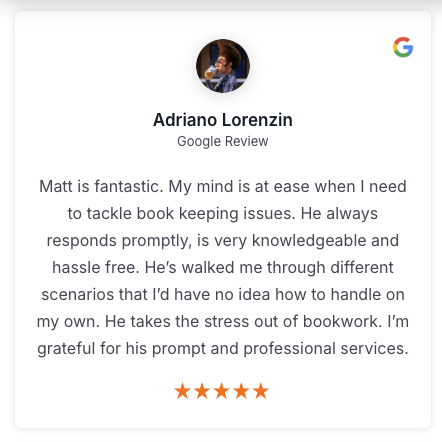
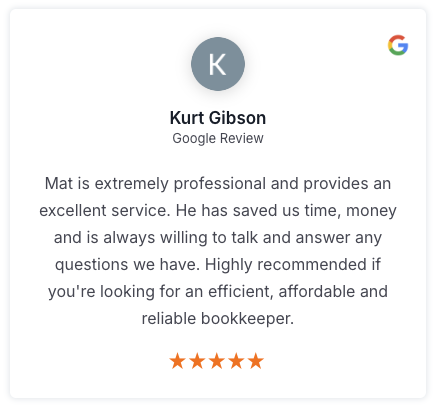
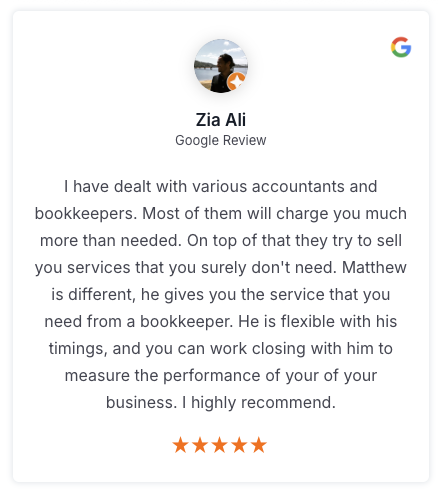
Matthew is known for being accessible. Clients regularly comment that he responds quickly, handles problems promptly, and communicates in plain language rather than accounting jargon. He works with business owners across any industry who provide services or sell products, manages bookkeeping remotely, and takes on new clients with the intent of building a long-term relationship rather than processing a transaction.
Bookkeeping packages start from $150 per month. The first consultation is free.
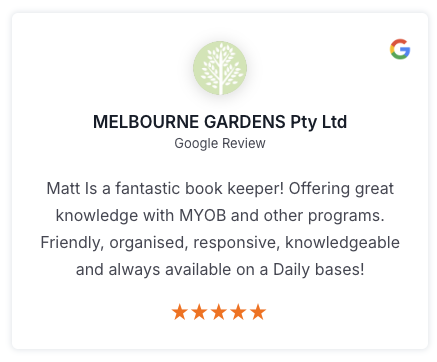
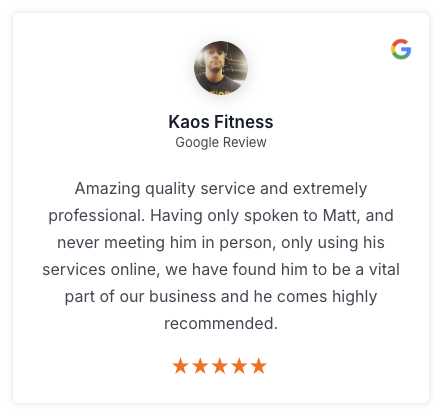
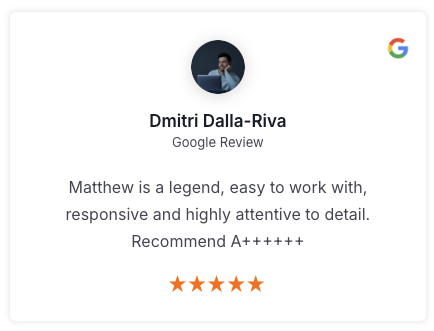
Read some of our bookkeeping case studies
Below are real life examples from businesses like yours who needed to use a bookkeeper.











Frequently asked questions restaurant owners ask before hiring a bookkeeper
Do I need to change my accounting software to work with you?
Not necessarily. Matthew works across MYOB, Xero and QuickBooks and can work within the system your restaurant already uses. If the current setup is not fit for purpose, he will tell you that clearly and explain what a better configuration would look like before any change is made.
Can you reconcile our delivery platform settlements?
Yes. Correctly recording and reconciling Uber Eats, DoorDash, Menulog and other platform settlements is a specific part of the service for hospitality clients. This includes applying the correct GST treatment to gross revenue rather than net deposits, which is one of the most common BAS errors in restaurants using delivery platforms.
How does payroll work for casual staff under the hospitality award?
The Restaurant Industry Award covers most hospitality employees and includes penalty rates for evenings, weekends and public holidays that vary by classification level. Matthew processes payroll under the correct award classification for each employee, applies the right rates for each shift type and lodges STP reports with the ATO every payday. If your current payroll setup has not been reviewed against the current award rates, that review is part of the onboarding process.
The books for our restaurant are a mess, can a bookkeeper fix them?
Yes. Catch-up bookkeeping and file remediation are a standard part of the service. Matthew has extensive experience bringing accounts that have fallen behind back to a clean, reconciled state, including identifying and correcting errors in GST coding, payroll classification and supplier invoice allocation. The starting point is a review of where things stand and a clear plan for what it will take to get them right.
What is the BAS lodgment extension and how does it help our cash flow?
As a registered BAS agent, Matthew’s clients receive an automatic four-week extension on their quarterly BAS lodgment deadline. That extension applies to the payment of any GST owing as well as the paperwork, giving the restaurant additional time to manage cash flow before the payment is due. For a business with tight margins and variable weekly revenue, four extra weeks of working capital four times a year is a genuine financial benefit.
What does bookkeeping cost for a restaurant?
Packages start from $150 per month and are structured around what your restaurant actually needs. A small cafe with a simple setup has different requirements from a multi-staff venue with delivery platforms, function bookings and associates. The first consultation is free and Matthew will give you a clear indication of what is involved and what it will cost before any engagement begins.
Ready to get the financial side of your restaurant managed by a bookkeeper?
- You already know the books are not where they should be.
- You know the BAS gets done in a rush.
- You know you are not entirely sure the payroll rates are right.
- You know your accountant asks for things at tax time that take longer to find than they should.
- You have known all of this for a while now, and every month that passes without doing something about it is a month of risk accumulating quietly in the background.
One conversation with Matthew Powell will not cost you anything. Leaving it another month might.
Packages from
$150 per month
Structured around what your business actually needs
Registered & certified bookkeeper
Latest insights




Other industries we service